Wednesday, September 11, 2013

Sailing in the Whitsundays!

The Whitsundays are located 1100km north of Brisbane and 630km south of Cairns, right in the heart of the Great Barrier Reef. They are a group of 74 islands off the Queensland coast in the Coral Sea, 66 of which are left in their natural state with no buildings or resorts. I had visited the Whitsundays in September 2009 on my way down the east coast before heading home and I absolutely loved it, which is why I had to bring Mom and Dad here on their whirlwind tour. We were all looking forward to four days of sailing, snorkelling and sunshine, we just had to get there first.

On the map of Australia in the upper left corner, Karratha is almost 
directly across from the Whitsundays, on the west coast

After spending the night in Brisbane, we boarded our early morning flight to Proserpine, home of the Whitsunday Coast Airport. Airlie Beach, our base in the Whitsundays, was another hour away by bus, but we had an entertaining bus driver and it passed quickly. I had stayed in Airlie Beach before, but in a youth hostel. This time around, we were staying at the lovely Airlie Beach Hotel right on the Esplanade. Our ship didn't sail until the next day at 7pm, so we had a day and a half to walk around and get acquainted with the 'drinking town with a sailing problem'. I remembered there was a terrific boardwalk from Airlie Beach to Cannonvale Beach, about 7km return. We walked past Abel Point Marina, where our ship the Solway Lass was docked, and ended up at Cannonvale Beach at low tide. I ran most of the boardwalk the following morning, as it hugs the ocean most of the way and you can't beat the scenery. We also took a bus to Shute Harbour, which also has beautiful views of the Whitsundays. It's a gorgeous part of the world and I'm lucky to have visited it twice.

Abel Point Marina 

Abel Point Marina at sunset
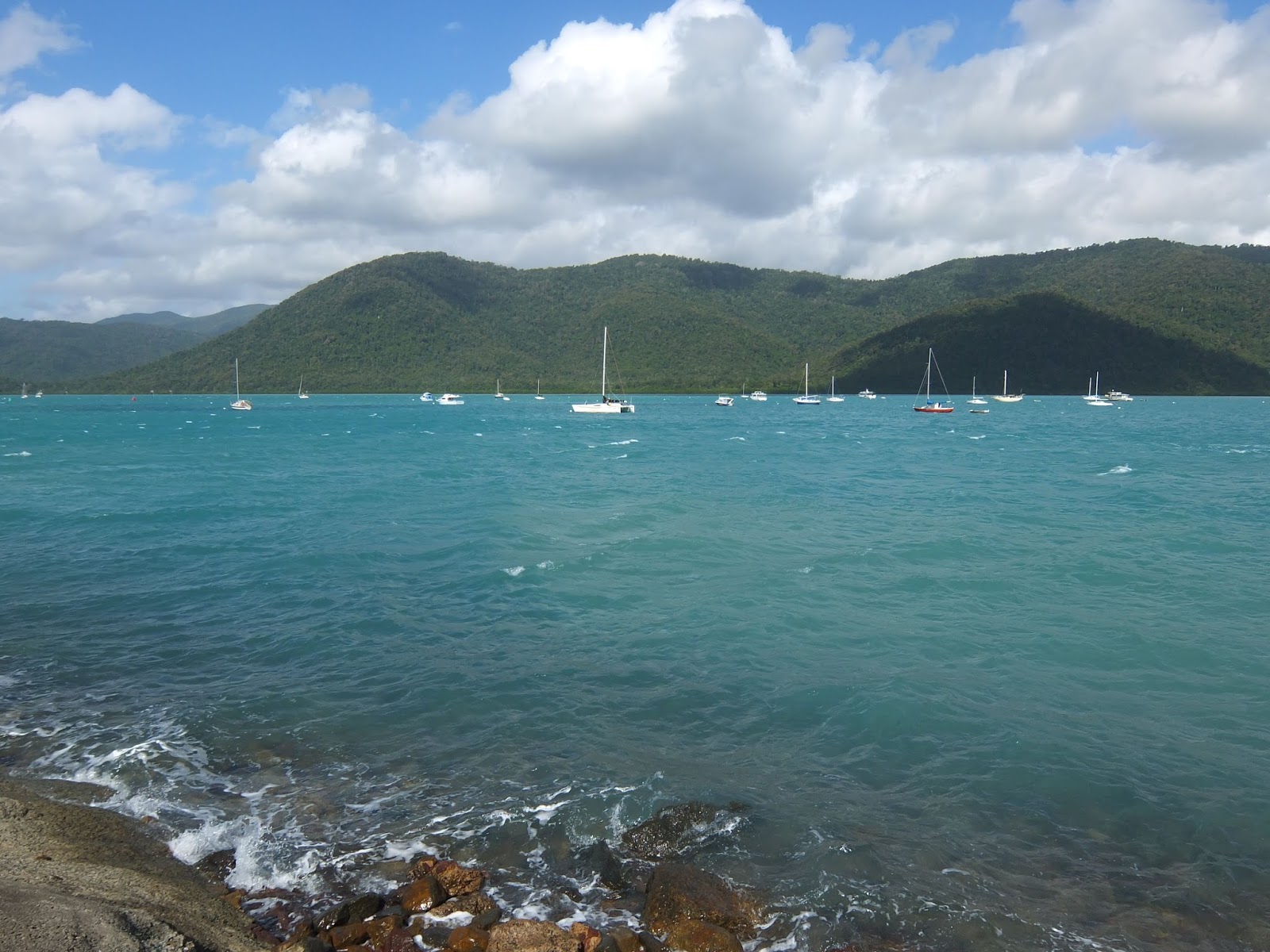
Shute Harbour the next morning

Shute Harbour


The Solway Lass in its berth

At 6:30pm on Tuesday, we got on a bus near our hotel with close to 30 other travellers for the short drive down to the marina. We then boarded our home for the next three days, the Solway Lass (www.solwaylass.com). After being introduced to our crew of five and given a tour of the tall ship, we settled in for the evening. We were sailing for a couple of hours before anchoring for the night. While the weather had been mostly good during the day, the wind had definitely picked up now that it was dark and the sea was choppy. While I don't usually get seasick, I was glad I had bought some ginger tablets that afternoon. They would definitely come in handy over the next few days! We anchored for the night in Macona Inlet at Hook Island around ten, had some delicious, made from scratch vegetable soup by chef Eddie and headed to our cabins and bed.

We awoke to more wind and some rain. With temperatures in the mid to high twenties, hardly any wind and less tourists, July is supposed to be the perfect time to sail the Whitsundays. However, the forecast for July 9-12 was showers with patches of sunshine and that's exactly what we got. Breakfast was at seven and then we took off for Whitsunday Island and the world famous Whitehaven Beach. That morning's sail was the roughest I have ever experienced. Our ship was listing up to 33 degrees to either side and several waves broke over the sides and soaked the deck. I normally don't get seasick (one of the only times I can remember is crossing from Melbourne to Devonport on the Spirit of Tasmania on the Bass Strait~ that was so long and awful, when I was done touring Tasmania I chose to fly back to Melbourne from Launceston instead) and while I didn't throw up like some others on board, I did feel absolutely nauseous and couldn't wait to set foot back on land. This trip couldn't be over soon enough. After ~3 hours, we anchored in Tongue Bay and had lunch. I managed to choke a bit of food down before we took the tender out to Whitsunday Island. After a short hike, we arrived at Whitehaven Beach. 

Whitehaven Beach was awarded two Travellers' Choice Beach Awards by TripAdvisor in 2013: No.1 beach in Australia and No.3 beach in the world.  It is definitely one of the most beautiful beaches I have ever been on and on this particular afternoon we had it all to ourselves. It was a bit cool and quite windy, but the sun had come out and it wasn't raining, so that was a plus. We walked along the the length, taking photos while other people in our group donned stinger suits (to protect themselves from jellyfish stings) and went for a dip. We had been warned not to take any of the sand from Whitehaven Beach as the fine was very steep (steeper than if you were found carrying cocaine!). It's 98% silica and since none of the local rocks contain silica, it's thought that it was brought to the beach by prevailing sea currents over millions of years. The bus driver had also mentioned that NASA used it in the creation of the Hubble Space Telescope. It is very fine sand, a danger to cameras and other electronics~ could be why my first digital camera's shutter needs a flick to open after I visited in 2009. No mishaps this year though! 


 The waves were a little too quick for me...

 Mom and Dad on Whitehaven

We met up with Brandon, our barman on the ship and our guide for the afternoon, and the rest of the group to hike up to the view point. Hill Inlet is different every day and I wish I had photos of when I was up there 4 years ago (they're on my older laptop) to compare. Unfortunately we didn't have a lot of time before we had to return to the boat, so we quickly snapped a few shots (I think Dad got better ones with his DSLR) and made our way back down. I wasn't too eager to get back on and sail to our next anchorage (I still felt a little queasy and the tender only held ~10 people), so I stayed on the beach looking at the coral that had washed up (the entire beach was made up of bleached coral). Brandon and the tender returned for the final trip and we said goodbye to Whitsunday Island.
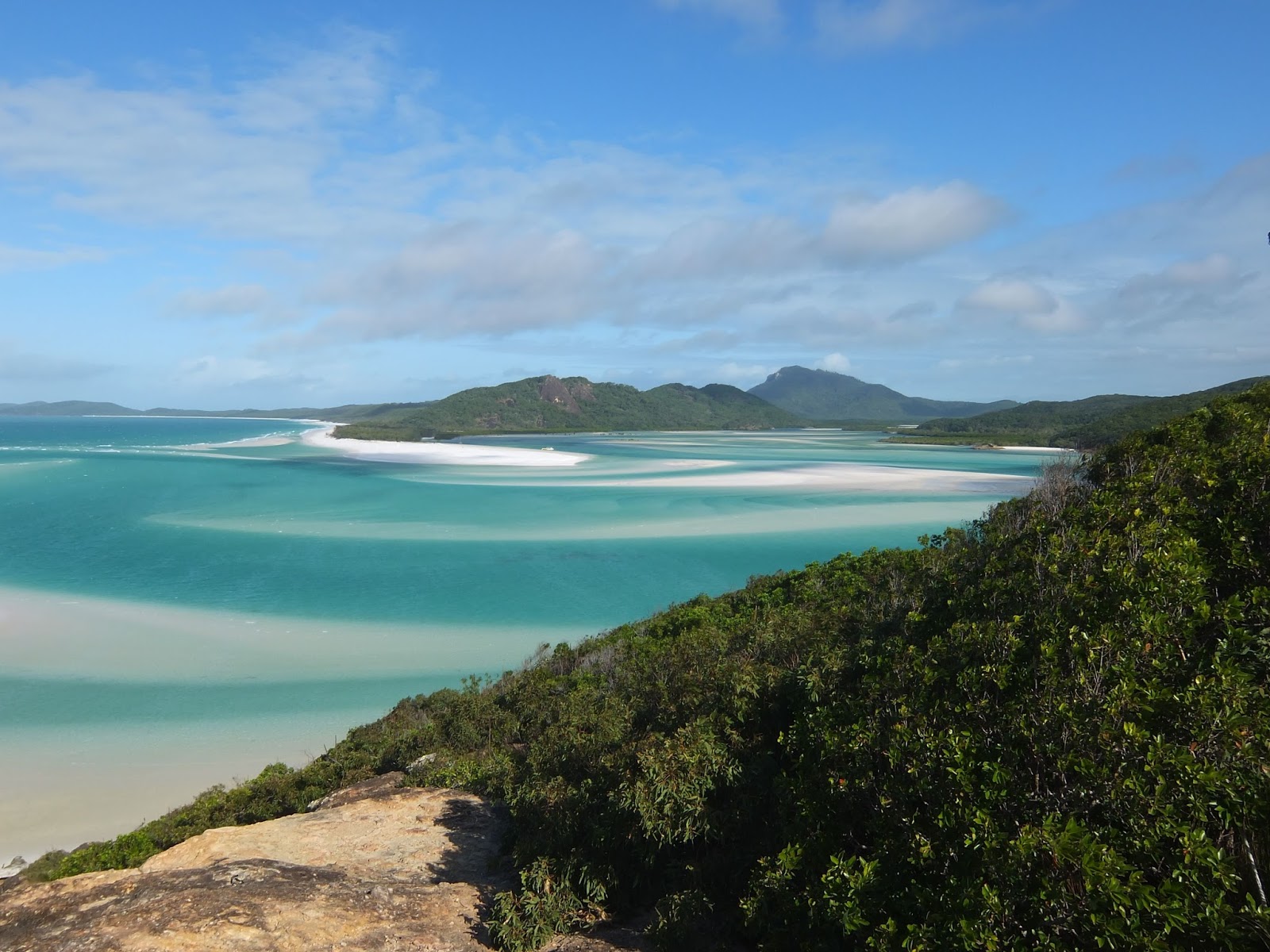
 The view of Hill Inlet

Another view of Hill Inlet

Coral

We had a much gentler sail on our return to Hook Island. It was still a bit rough (especially considering that the waters around the Whitsundays are usually as flat as glass), but it was much more manageable. We overnighted in Nara Inlet, just to the west of Macona Inlet, where we had anchored the night before. While waiting for our dinner, some dolphins were playing around the ship; they seemed to like the light from the torches/flashlights. Dinner was Thai green curry chicken~ it was quite amazing what Eddie could cook up for 30+ people in a galley only slightly larger than my bathroom. He had Emma, a Canadian(!) volunteer, help him with cutting up veg and cleaning up, but he did the bulk of it himself and it was always high quality. Well done, Eddie!

The next day, after an early breakfast on the deck, we headed north to Hayman Island, which houses a 5 star luxury resort currently undergoing a $40 million revamp. Rates in the off-season start at $590 and go to $8000 (for a 3 bedroom owner's penthouse) per night. Not quite in my price range, which is why I was sharing a ver small cabin with my parents. There was room for a double bed with a single bunk on top and about 2m x 0.5m space in front of the beds. The Solway Lass anchored in Blue Pearl Bay on Hayman's northwest side and Braydon, one of the deckhands, make several trips with the tender to drop us off on the island. Mom and I put on our stinger suits (very attractive!) and our masks and snorkels, and waded into the ocean. Close to shore there wasn't much sea life or coral, but the further out we ventured, the more we saw. Every time I go snorkelling I wish I knew what I was looking at. We saw lots of fish, many of them multi-coloured, quite a few clams (some were very big and their 'lips' were a bright blue or purple) and lots of different kinds of coral. No underwater camera this time, so I just tried to absorb as much as I could. It was amazing to see the variety of sea life~ there were so many fish and they came in all different kinds of colours and patterns. So happy Mom got to snorkel the Great Barrier Reef, it really is an extraordinary experience. Reluctantly we joined Dad in the tender and returned to the ship. It was time for lunch.

That afternoon we sailed around Hayman and headed to Maureen's Cove, on the north side of Hook Island. Here we had another opportunity to snorkel and I jumped at the chance. This time we had to get in the water from the tender, and the water was cold! The coral here was more colourful than it had been near Hayman (green! blue! purple! pink!), and there were more kinds of fish here as well. The wind had picked up, but as long as you kept your face in the water, it was fine. Mom and Dad stayed in the glass bottom boat and got to see the reef from above. They saw a sea turtle, which I missed, but I had swam with one last time I had been to the Great Barrier Reef. After being pulled back into the tender, we returned to the ship, where some of our group were using the rope swing. Everyone was in a great mood after having had such a successful day on the reef and we had a great sail to our last night's anchorage in Baird Point on Hook Island.

On our last day at sea, the wind conditions were just right and the crew opened all the sails. We had had had some of the sails open on some of the other days, but today all the sails were open. They enlisted some of the passengers to help, and I got to hoist one of the sails (possibly the jib? I can't remember...) while Brandon yelled at me to "HEAVE!" and to "Put (my) back into it, sailor!" Nothing like a little encouragement... We sailed to South Molle Island to hike Spion Kop Track, a lovely hike through eucalypt forest, rainforest and open grassland. We had great views of the islands around South Molle, including Hook, Whitsunday and Hamilton. We had done a more difficult hike 4 years ago to an amazing viewpoint overlooking the Solway Lass in an inlet, but this walk had great views all around, especially from the platform at the end. The rain held off while we were on the island and the sun even came out for awhile. Back on board the ship, we prepared for the journey home.

Some of the steps on our walk

 The Solway Lass is the one closest to the centre, with the dark hull

 Some of the 74 islands of the Whitsundays

 One of my favourite flowers, a hibiscus

 Grass trees!

Being a sailor is a lot of work! 
Brandon and Braydon taking down one of the sails.

Watching the crew take down the sails was quite the show. Wearing harnesses that hooked into the rigging, the climbed up the ladders and balanced on ropes while folding the sails neatly and tying them up . This was made a bit more difficult due to the wind and rain, but they worked quickly and efficiently, and they received a round of applause once they were done. After another couple of hours of sailing, we were back at Airlie Beach. Our captain, Reese, had the onerous task of backing the ship into its berth. After saying goodbye to our new friends, who came from Holland, Norway, Wales, Byron Bay, Melbourne, Adelaide, Perth and Canada (Ontario), and to the crew, we returned to our hotel to shower (only 2 minute showers were allowed on the ship and mine was lukewarm at best) and pack. Part two of our holiday was over and it was time to prepare for the second half. We would be flying to Melbourne in the morning, the starting point of our road trip. Great Ocean Road, here we come!

Wednesday, August 7, 2013

Exploring the Pilbara

No wonder some of you think I'm always on holidays~ it's all I ever write about! Last term was a busy term for me, and I spent a lot of time in front of the computer preparing reports for the end of semester one. I also tried to meet with as many of my students' parents as possible before reports were sent home, so there would be no surprises. I simply didn't have the time or the motivation to write anything for the blog. We'll see if things slow down a bit in Term 3, which is ten weeks long.

The first two weeks have passed rather quickly. We had two days of professional development to start, with some sessions on the new Australian Curriculum for English and Maths (Each state in Australia used to have its own curriculum, however they are currently transitioning to a country-wide curriculum, which means I am teaching AC English, Maths and History (Social Studies), but Western Australian Syllabus Art, Technology & Enterprise and Health). We also had the opportunity to check out the new Leisureplex, a $63.7 million dollar recreation facility that boasts a 25m pool, a 50m pool, a splash park, a variety of different indoor and outdoor sport courts (we played badminton and beach volleyball), glow in the dark mini golf, a fitness centre and a cafe. I had gone to the open house at the end of June and it really is quite spectacular, especially for a town the size of Karratha (population ~20 000). It is similar to the Terwillegar Rec Centre, although a bit smaller and the pools are outdoors. They also held an outdoor concert during opening weekend featuring Pete Murray, a well known Australian singer songwriter. It was a unique concert experience as we sat in plastic lawn chairs on the outdoor basketball court- can't say I've done that before! The remaining three days with the kids went by fast. I got my first birthday gift from a student (it's the first time my birthday was (almost) during the term- it was on the Saturday after term 2 was over), which was very sweet. It felt a bit odd to be teaching in July, but then it felt odd to be teaching in February when it was 40 degrees Celsius outside too.


The beginning of July meant my parents were making the long haul flight to come visit me in Australia. They left Edmonton on June 29 on the first of five flights to Karratha. After flying through Calgary, Los Angeles, Sydney and Perth, where they had two days to walk around and see the sights, they finally made it the evening of July 3. Still a little jet-lagged, we had a good catch up over dinner, although Mom fell asleep looking at my photographs of New Zealand on my laptop! The following day I had to work, so they explored Karratha on foot until I arrived home just after 3pm. We set off for Deep Gorge to check out the Indigenous rock art found there. I had been the week before on my own and had spotted maybe a dozen or so petroglyphs, but with Mom and Dad we found way more. Dad was like a mountain goat, climbing up on the rocks to get better photographs and he seemed to enjoy it much more that I had thought he would. There were a couple of Grey Nomads (Australia's equivalent to Canada's Snowbirds) there as well, and everybody was pointing out what they saw to the others.

 Handprints


 Reminds me of a scarecrow

 A boomerang

 A turtle

Leaving the Gorge, we saw some euros (defined as a stocky kangaroo by the Karratha Visitor Centre), which were the first native animals my parents had seen since arriving in Australia. Very exciting, but they were very quick~ Dad might have caught a picture, but I certainly didn't (didn't help that I was driving)! We continued down the road to the shelly beach at Hearson's Cove, which Mom really loved. It was already dusk and we didn't stay long. Driving back past Deep Gorge, I spotted something moving across the road~ it was an echidna! Echidnas are egg laying mammals of the monotreme order, as are platypuses. I had seen them before, in Tasmania and Victoria, but several Australians have told me they've never seen one, so that made it even more special. It kept burrowing its head, but if we were still it would pop its head out and progress a little further. Very cute!

Our echidna!

The next day we headed off to Point Samson, 50 kilometres east of Karratha. We had Honeymoon Cove all to ourselves, quite a change from the last time I had been there in March when it was packed. Someone had left what looked like a petrified fish on one of the wooden fence posts. It was leathery and a bit square shaped. The picture doesn't do it justice.


We also went to Point Samson Beach where Dad dipped his feet wet in the Indian Ocean for the first time. Afterwards we headed to Tata's for lunch~ chicken fajitas for Mom and I and fish fajitas for Dad. Sorry, Danielle Sasaki, no food pictures, although they looked amazing and tasted delicious!


We checked out Cossack, an historical town with many restored buildings dating from the late 19th century. The Pilbara gold rush brought thousands of fortune seekers here, and pearling used to be a big industry before it moved further north to Broome. My students had come here on an all-day field trip in year 3 to learn about the history of the area. It reminds me a bit of Fort Edmonton, but only because the buildings have all been restored~ there aren't any interpreters (I don't think, maybe they do something with school programs that I haven't heard about).


We then drove past Karratha and headed to Dampier which, according to last year's census data, is the richest town in Australia with 22% of households earning $4000 or more per week (Karratha, by the way, is second with 19% of households earning $4000 or more per week). It is the world's second largest bulk export port, exporting iron ore, salt and liquified natural gas, among other things. It is also home to the famous Red Dog, a Kelpie cross famous for hitching rides and travelling all over the Pilbara (the region on North West Australia where Karratha and Dampier are found). Nicole had taken me to see the Red Dog statue in Dampier in March, but I still hadn't seen the 2011 movie (remedied the following night, thanks to Leesa). We stopped at the statue, took the requisite photo, made a loop around town and ended up at the palms.

Back in March, with temps close to 40, Red Dog was HOT!

The palms~ hard to see in this photo, but there's a lovely patch of grass underneath, great for sun baking, reading a good book, hanging out with friends...

We drove out to Milstream Chichester National Park on Saturday. I hadn't yet been, but had heard good things about Python Pool, so off we went. Two hours later (and after stopping to take pictures of termite mounds), we found ourselves at Mount Herbert, a must climb for my father, whose name is Herbert. Thankfully for my Dad, Australian mountains are very short and we summited in less than 15 minutes (oh, how I miss hiking in the Rockies!). Great views from the top though, I do love the contrasting colours of the Pilbara. Python Pool was our lunch stop. It was a tranquil spot that we had all to ourselves, at least until the five Grey Nomads arrived. Driving back we stopped at Miaree Pool for a quick look (I can see why kids would love it during the hot summer months), and then parked at the Leisureplex so we could climb the hill behind for a sunset view of Karratha. 

Standing in front of a termite mound

Herbert about to summit his namesake

View from the top

Python Pool

Karratha~ My house is somewhere in the centre

We returned home and settled in to watch Red Dog. I enjoyed it much more than I thought I would, might even have to buy it as my souvenir of the Pilbara. If you're looking for a good Australian film, I definitely recommend it. It's actually available at the Edmonton Public Library, Jay Shack and Ray Tubbs! Check it out, you'll be able to see the region where I've been living the last six months!

In the morning, after packing, we were invited to my friend Robyn's house for morning tea. Robyn is an amazing quilter and I thought Mom would like to see some of her work (I wish I had a photo to show you, they are works of art). Robyn's husband Gary and my Dad talked on one end of the table while the women chatted about travel, family, quilts and fabric. Seeing Robyn's sewing room with the variety of fabrics, as well as her finished quilts (especially the one she made after travelling through the Kimberley) inspired Mom to pick up some Indigenous art fabric from a store in Alice Springs, something she's never done before. I'm looking forward to seeing what she creates with it. Thanks Robyn and Gary for the lovely visit!

The first part of our four part holiday was over. We had a 1:30 flight out of Karratha to Brisbane, via Perth of course. We had a three day sailing trip in the beautiful Whitsundays booked for Tuesday and I, for one, couldn't wait to set sail. Thanks, Jenny, for getting us to the airport in time and for picking me up at the end of my holiday as well. It was over much too quickly!

Saturday, June 1, 2013

April School Holidays, Part II

After spending a week in Perth, I boarded my plane for the 2 1/2 hour flight to Broome. I had been to Broome the last time I was in Australia, but it was the gateway to Cape Leveque, my ultimate destination. The tour left bright and early Saturday morning, so I spent Friday afternoon poking around China Town. Staircase to the Moon was on that weekend, which is why I went to Town Beach to check it out. Staircase to the Moon is a natural phenomenon that occurs in the Kimberley (where Broome is) and the Pilbara (where Karratha is). It is caused by the rising of the full moon reflecting off the exposed mudflats at low tide, which creates a beautiful illusion of stairs reaching to the moon. Unfortunately the sky clouded over and there was no moon to see. You can't see it on Cape Leveque (there are no mudflats), so I was out of luck this time. However, you can see it from Hearson's Cove, which is close to Karratha, so I may have another opportunity later this year.


The next morning I was picked up at 7am by Russell, our tour leader for the next three days. Accompanying me were two older couples from Victoria (the state in Australia, not the city in BC), a retired radio journalist from Sydney and a fellow backpacker from Calgary, Alberta (it's a small world!). After picking everyone up from their various hotels and hostels, we were on our way north. After travelling for a short while on the paved highway, we turned off onto the red dirt road that would lead to Cape Leveque. It was quite bumpy and rugged and Russell mentioned that it was one of the worst dirt roads in WA (he said this to reassure the others, who were all going on a five day tour to the Bungle Bungles immediately following this tour). I didn't find it that bad and I think we were on it for less than two hours all together. Our first stop was Beagle Bay, an Indigenous community that was first established by Trappist Monks around 1890. The Sacred Heart Church is famous for its mother of pearl shell altar, hand built by the local Indigenous people and finished in 1918. 

The Sacred Heart Church in Beagle Bay

The famous mother of pearl shell altar

We hopped back on the bus to continue on to Cape Leveque. We were staying at Kooljaman, an
Indigenous owned wilderness camp located on the tip of the Dampier Peninsula. We had lunch (Russell set out quite the spread: 4 different kinds of salad, cold cuts, a cheese platter, bread, wraps, veggies and more) and then most of us headed out to Eastern Beach. After spraying on some sunscreen (a must when it's hotter than 35 degrees Celsius) and talking to Thor, my fellow Albertan, about our travels, I went for a swim in the warm waters of the Indian Ocean. It was awesome to just float in the salt water, rising and falling with the waves. Afterwards I went for a walk among the sand dunes before returning to camp for a shower.

Eastern Beach

We almost had the whole beach to ourselves

More red rocks

The sky had clouded over again, so no picturesque sunset photos. Instead the seven of us sat around the picnic table while Russell BBQed. On the menu was Scotch fillet, kangaroo (a chicken breast for me, the non red meat eater of the group), mashed potatoes, caramelized onions, vegetables, garlic bread and left over salads from lunch. Russell proved to be a good cook once again as we all dug in. An early night followed, as we got tired of fighting off the flies and mozzies.

After breakfast, we had some time to ourselves, so I went for a walk along the red cliffs of the Western Beach. These red cliffs are what had drawn me to Cape Leveque and they are indeed beautiful. If I had had even more time I would have loved to have walked around the tip of the cape to the Eastern Beach, but I walked through the wilderness camp, with a brief stop at the lighthouse, instead. Back in the water Thor and I met a couple of fellow Canadians (from Ontario) who were living in Perth. After talking about some cultural differences and what life is like living in Oz (food is so expensive! the climate is lovely!), Thor and I headed back to camp to shower before boarding the bus. We were off to Lombadina, an almost self-sufficient Indigenous community located close to Kooljaman. It was very quiet when we arrived and the only person we saw was the priest, a Kenyan who had found his home here, caring for Indigenous Australians. The church was like no other I'd ever seen. Constructed of timber, with open air windows, it was beautiful in its simplicity.


The church from a distance 
(I was trying to avoid having other people in my shot, which is why it's so far away)

We then headed east across the peninsula to Cygnet Bay Pearl Farm, Australia's oldest operating pearl farm. Pearling has been an important industry in Western Australia for a long time and in the early 1900's it centred around Broome. Dean Murdoch Brown began Cygnet Bay Pearl Farm in 1946 by collecting mother of pearl shell. When his son Lyndon entered the business, he learned how to seed a pearl shell, something previously only done by the Japanese. His other son brought the first non-hard hat diver to the industry. Today the company is continuing to expand with accommodation, dining and tours available to those who come visit the bay. We had arrived in time for lunch, an amazing spread of chicken, pork, fries, three different kinds of salad, vegetables and dessert. After our feed, we had our tour of the pearl farm. Pearling has a fascinating history, but it's not without its horror stories either. Some companies treated their Indigenous, Chinese and Japanese divers abominably; for example, sending pregnant Indigenous women down for shell because they believed their bodies could hold more oxygen and they could stay down longer. Fortunately, Cygnet Bay treated those that worked for them respectfully and continue to do so today. I was surprised to learn how much time and work is put into creating pearls and I now have a much better understanding of why the genuine article costs so much (over $AUS300 for a small set of studs, thousands of dollars for a strand). For more information, check out the Cygnet Bay Pearl Farm's incredibly informative website, http://cygnetbaypearls.com.au. 

The Kimberley has the second biggest tidal variation in the world (the biggest is in the Bay of Fundy in New Brunswick, Canada) and five of us decided to experience it firsthand by taking a boat on to King Sound. These giant tides are responsible for the Horizontal Waterfalls, found in Talbot Bay, east of Cygnet Bay. The boat ride was amazing, going through whirlpools and looking at the moving tides up close. It was a great ride.

Horizontal Waterfalls (on my list of things to see)- source

The fast moving giant tides of King Sound

The sunset on Sunday was spectacular, but unfortunately we were on the bus back to Kooljaman and missed the best part. I did, however, capture this shot of the aftermath. Can't see the famous red cliffs of Cape Leveque though!


Monday morning I woke early (mostly because we were all in our own tents before 9pm the night before) and decided to walk down to the Eastern Beach to catch the sunrise. I was a little late, but better late than not at all. I followed that up by a swim in the ocean, empty at this time except for one other person. It was awesome. Everyday should start with a swim in the sea!


Following breakfast with the group, we had a bush tucker tour with Bundy, an Indigenous guide who shared his Bardi culture with us. Bundy taught us about the birds and how they can tell can us where to find food and water, or when there's danger nearby. He told us about a plum-like fruit that contains 50 times the amount of vitamin C found in an orange. He also taught us about a root that the Aboriginals use to stun fish. This article http://au.news.yahoo.com/thewest/travel/a/-/travel/16424027/reading-nature-a-lesson-in-survival/ does a much better job than I do at explaining Bundy's stories and is worth a read. After Bundy's tour, we took off for One Arm Point, another Indigenous community east of Kooljaman. We stopped at a lovely beach first (where we weren't allowed to swim because of crocodiles), and then we proceeded to the Ardyaloon Hatchery, where Barry introduced us to the different fish species they kept in the tanks. We then learned about the trochus shell, which they specialized in, and which they used every part of the shell to make jewelry and other trinkets. After a filling lunch overlooking the giant tides of King Sound, we boarded the bus for the drive back to Broome. Our three day adventure on Cape Leveque was over.

A trochus shell (source)

The view from the hatchery

The road back to Broome

I had three days in Broome before heading back to Karratha, so I decided to hire a bike to get around, as the town is quite spread out. The first day I biked to Gantheaume Point, which is on the south west end of the peninsula. I had come hoping to see 130 million year old dinosaur footprints, but unfortunately the tide, while low, wasn't low enough to see them. I did see the cast of prints, which is at the end of the path from the lighthouse, but that's not as exciting as seeing the real thing. I loved the pindan rocks around the Point~ the contrast between the rocks and the ocean is beautiful. I then biked north to Cable Beach which, according to my tourist map, is Australia's only beach rated in the world's top 5. It is named after the telegraph cable that was installed between Broome and Java in 1889. Twenty-two kilometres long, its white sand and azure waters seem to stretch forever. I stayed the afternoon, alternating between swimming in the warm water (love it!) and reading on the beach. I rode back to the hostel before sunset as I wanted to shower and eat before going to Sun Pictures, the world's oldest operating picture gardens, to see Silver Linings Playbook. The last time I was in Broome I had seen the movie Australia with Nicole Kidman and Hugh Jackman~ what a perfect place to take it in (Sun Pictures itself is in Australia). Silver Linings Playbook was good, but it was funny when the helicopters flew overhead on route to the airport and drowned out the dialogue.

The next day I decided to bike the 20 or so kilometres to 12 Mile to visit The Mango Place (http://www.mangowine.com.au). A farm, a store and a cafe, The Mango Place was a cool oasis after my sweaty, hot ride and I thoroughly enjoyed my refreshing mango smoothie. They also served mango cake, ice cream, wine, chutney, jam, vinegar, dressing, tea and candy. In the store, they sold pindan (the rich red dirt found in north west Australia) dyed clothing, soap, moisturizers and repellents. I was glad I had ridden out. I returned to Cable Beach for another afternoon of swimming and reading, snagging a great spot to watch the sunset camel ride, which I had done 4 years ago.

My last day in Broome was more of the same. I rode out to Deep Water Port and to Entrance Point in the south east corner (nothing spectacular, I just wanted to go somewhere I hadn't been before), then I parked the bike and walked along a red dirt road to Reddell Beach, which I had completely to myself. It was beautiful and I'm glad I made a point of going somewhere different. I rode back to Cable Beach via Gantheaume Point for the afternoon, enjoying my last day in the ocean. I had had an incredible two weeks, but I was looking forward to returning 'home' and sleeping in my own bed. I was happy to have three days (my flight got in before noon on Friday) to recoup before heading back to work on Monday.

The rocks around Gantheaume Point


Cable Beach, looking south

Check out the water temperature!

Sunset on Cable Beach

The iconic camel ride

Just as everyone had told me, temperatures have dropped since April school holidays. In fact, it's been unusually cool and rainy, and we haven't seen the sun in a few days. If this is winter, I could get used to it, although I do miss the sunshine. The forecast for this long weekend (it's Western Australia Day on Monday) calls for more rain, which will make it easier to sit in front of the computer and write my report cards, due in two weeks. That might just be my next entry, we'll just have to see what else happens in the next few weeks!

Wednesday, May 15, 2013

April School Holidays, Part I

One of the big differences between schooling in Alberta and schooling in Western Australia is the school year itself. In most schools in Alberta, we start school in late August/early September, we teach until Christmas break, which is two weeks long, then we teach again until the end of March, when we get one week off for Spring Break. Three more months of teaching follow, with school ending the last week of June, and then we get almost two months of holidays before beginning another school year. In WA, the school year starts at the beginning of February, we teach for 11 weeks, then we get a two week holiday in April. That's followed by a 9 week term and another two week holiday in July. Term 3 lasts until the end of September with another two week break, and the final term goes until Christmas, or December 20th this year. This is why I was able to enjoy four weeks in New Zealand before starting Term 1 and why I just returned from holidays prior to starting Term 2 last week. At this stage, I'm enjoying Australia's school year better, but ask me in August, when I'll be teaching and all of my Canadian colleagues will be on holiday and I might have a different opinion!

For April school holidays, I knew before I arrived in Karratha that I wanted to visit Cape Leveque, which is 200km north of Broome. When I was in WA before, I participated in an Australian Conservation Volunteers program in the Bungle Bungles. Our program leader had led a volunteer group in Cape Leveque and had shared photos with us of the experience. Its stunning beauty really stuck in my head and when I knew I would be living in Karratha, I couldn't not go. Once that was organized, I decided to spend the time before and after the tour in Broome and the week prior to the tour in Perth. Check out the map to find Karratha, Broome, Cape Leveque and Perth.


I flew out of Karratha Friday night and arrived in Perth around 9:30pm. I took a taxi from the domestic airport to Claremont, where Emma's parents, Georgi and Simon, live. I would be staying with them for my week in Perth. Emma is my exchange partner. She is living in my condo in Edmonton and teaching my former grade 4 students at Esther Starkman School. I had met Emma's parents when I had arrived from Auckland and had one night with them before departing for Karratha. They were very kind and welcoming and I was excited to see them again. I knew I would have a fantastic week in Perth. 

My first day with Georgi and Simon was very educational~ I learned all about AFL, or the Australian Football League. Georgi cheers for the Fremantle Dockers and Simon cheers for the West Coast Eagles, and there was a double header that day, so we watched both games. It's a very fast moving game, with lots of action. While I'm still unsure of all the rules, I did enjoy watching the games (the men aren't bad to look at either!) and I hope I get the opportunity to watch one live at some point this year. Check out this Youtube clip for highlights from a Dockers and Eagles game: https://www.youtube.com/watch?v=ogOeSWcaijQ

On Sunday, after a lovely breakfast with Georgi and Simon's friends, Rob and Sheryl, I took the train to Fremantle. South of Perth, Freo is an artsy, heritage district with some of WA's oldest buildings. I had been before, but it was good to go again and I was looking forward to visiting the markets. After lunch at Gino's, I walked to the Round House, the oldest surviving building in WA. Built in 1831, the 12 sided stone prison was the site of the colony's first hangings. I also went to the Maritime Museum, where I saw the Australia II, the yacht that won the America's Cup in 1983 (a huge deal because it broke America's 132 year winning streak), and Megamouth, a species of shark with a very big mouth (hence the name!) of which only five have been found. 

The next day I took the train into Perth's CBD and walked up to Northbridge to visit the Art Gallery of Western Australia. They had an exhibit from the Museum of Modern Art in New York titled Picturing New York. It was a collection of black and white photographs by artists like Walker Evans, Alfred Stieglitz and Weegee, and it was excellent. The Year 12 Perspectives was also worthwhile with some very interesting pieces. Following lunch, I took a walk through the CBD to the Esplanade and then walked to Kings Park, one of my favourite places in Perth. Walking around the city brought back memories of when I housesat and worked in Subiaco. I remembered how much I loved Perth, how beautiful the parks, rivers and ocean are. I couldn't help thinking what my exchange experience would be like if I were placed in Perth, where the majority of the other exchange teachers in WA are. It would have been different, that's for sure, for lots of different reasons.

The view of Perth from Kings Park

Tuesday I met up with Sandy, a teacher who had done an exchange to Edmonton in 2011 to my old high school, Harry Ainlay, of all places. She had offered surfing lessons to the current group of exchange teachers in WA back in March, but because I'm up in Karratha I couldn't join them. I contacted her and explained my situation and she very kindly offered to teach me when I came down to Perth over April school holidays. We drove to Trigg Beach, put on wetsuits (the water is much cooler down south than it is up around Karratha) and jumped in. Two hours later, I still hadn't stood up, but I had a ton of fun. Paddling, riding the waves in, getting to my knees~ it was all part of the experience. I came close and maybe next time I try it I'll be successful. Sandy was a great teacher and had lots of pointers, I just wasn't coordinated enough to put it all together. Afterwards, we went for lunch and then drove to Hillarys Boat Harbour. We talked about our exchanges and how tough it can be to settle in to our new lives while on exchange. In so many ways you feel like a first year teacher again. There's a steep learning curve at the beginning and while it does get easier, it's still an uphill battle. It was reassuring to hear that her experience was similar to mine, that I wasn't the only one who feels a bit lost at times. It was awesome to talk to someone who had been through an exchange before, it really helped me put things into perspective.


Rottnest Island is 18km from Perth and I had not been before, so on Wednesday I took the 7:15 ferry and hired a bicycle to ride the 24km around the island. There are 63 beaches and 20 bays on Rottnest, which makes it a great getaway from the city, especially on a beautiful day like I had. I started in Thomson Bay, where the ferry arrived just after 8am, had a little walk around the settlement and hired my bike. I stopped at the Kingstown Barracks, then make my way to Parker Point and Little Salmon Bay. Both are known for their snorkelling, but I hadn't brought my gear with me as I thought the water might be too cold (it was, after all, autumn). I continued riding, heading to Cape Vlamingh, the western most point of the island. It was gorgeous! After taking some photos, I hopped back on my bike and went on to Ricey Beach, where I stopped to have a rest, a read and soak up the atmosphere. There were only two other families on the beach, so it was almost like having your own private place to relax. I was getting hungry so I rode on to Geordie Bay, the other settlement on the island. After a delicious lunch at the cafe, I backtracked to Parakeet Bay, where I braved the cold water and went for a swim. It was very refreshing! I make one last stop at Pinky Beach and the Bathurst Lighthouse before biking back to Thomson Bay to drop off my bike. I missed going into the museum, which explains Rottnest's history as a prison for Aboriginal boys and men in the 1800's, and as an internment camp for German, Austrian and Italian men during World War I and World War II. Walking around Rottnest is a treat. There are no cars, just a bus that makes its way around the island for those who don't like to cycle. All the buildings, including the cottages, are historic and you feel like you stepped back in time when you debark the ferry. I can understand why many Perth families escape to Rotto for the weekend.

 A map of the island

One of the beautiful bays

A quokka, a small marsupial found on Rottnest 
(hard to tell from the photo, but they're about the size of a cat)

My last day in Perth was ANZAC Day. ANZAC is the Australia and New Zealand Army Corps and every year on April 25th, Australians and New Zealanders remember those that fought and died in war. April 25th is the day the ANZAC soldiers landed in Gallipoli, in present day Turkey, and met with fierce resistance from the Ottoman Empire. Thousands died in the eight month campaign and and every year since there has been in ANZAC dawn service to commemorate the Australian, New Zealand and Pacific Island soldiers who died in battle. ANZAC Day seems to hold more importance then Remembrance Day, although I found the two holidays very similar. We had a service at school and the students made wreaths with poppies, just like we do for Remembrance Day in Canada. There was a service at Kings Park in Perth that was very well attended, but I had a lazy morning and slept in, so I didn't make it. I had been to the war memorial there on Monday, it was beautiful.


In the afternoon, I visited the Millpoint Caffe Bookshop (http://www.millpointbookcaffe.com.au/millpointcafe/Home.htm) in South Perth, managed by Adam, Rob and Sheryl's son. It was a cozy place with a really good vibe and I was quite happy to browse the shelves for a long while. Adam shared a couple of publisher copies of books so that I would have something to read on Cable Beach, which was very kind of him. They were both entertaining reads and well worth the space they took up in my backpack. At Georgi and Simon's that evening we had another delicious meal~ Simon really knows how to cook and had impressed me each night with something different and delicious. My dad could take lessons, especially now that he is retired! I'm going to miss his cooking; I haven't eaten that well since leaving home in December.

I left Perth the next morning for Broome, but those adventures are for another entry. Back in Karratha now and there's definitely been a weather change. Today it rained all day and the temperature was actually below 20 degrees Celsius (I didn't think it got that cold up here, but apparently it does). All the kids were wearing jumpers (hoodies) and complaining about the cold. I couldn't help but laugh as the kids back home would shed their jackets at the same temperature. I'm enjoying the cooler weather though, my run this morning was awesome! I don't think it's going to stick around long, but it's nice to have a change for awhile.